Tuesday, March 6, 2012

6 Tips for Coaching Your Own Child


Coaching a sports team can be difficult. When your own kids are playing on the squad…it can be even more challenging.

clip_image001

Here are six tips parents/coaches can use to keep things fun and constructive on and off the playing field.

1) Get their input...first. Ask your child to help you come up with a list of positive and negative items that may come up with you being the team’s coach. Listen to what you child has to say before making the final decision to come on board as coach. It's much better to get things clear early, rather than two months into a long, emotional season.

2) Take off your coach's hat at home. Don’t over-practice, or over-coach, with your child at home. Since you are the parent, and the coach, this could lead to your child feeling a bit overwhelmed and confused. Ultimately, this can lead to them wanting to quit the team. (And nobody wants that.)

3) Keep things fair and equal at all times. Be a parent at home, but be a coach at games and practices. The ability to make fair and honest decisions dealing with your children and other team members will strengthen the respect that your child will have for you. (As well as the rest of the team.)

4) Tell the truth. Be open and honest with other parents when dealing with team issues. (Even if they involve your kid.) There will always be disagreements between kids, or feelings of jealousy because you are the coach. Just remember to always handle those situations quickly, and with open communication.

5) Spread the praise around. Give your child praise, but avoid showing preferential treatment like giving extra playing time or special duties to your child. (Like picking the pizza joint for post-game dinners.) Conversely, avoid diminishing you child’s playing time or giving less one-on-one time in an effort to show that you are not playing favorites, as your child will begin to feel unfairly treated. It's a tough balance, but one that a coach/parent needs to be aware of. (This is especially true with pre-teen kids.)

6) Take a step back. If ever in doubt about how to treat a situation involving your son or daughter on the field, think of what you would do if you were dealing with a child other than your own. This could be an effective way to not only properly coach your own child, but might also help your relationship going forward.

Coach Heas

Monday, March 5, 2012

How to Prevent Rotator Cuff Injuries

The rotator cuff is made up of a group of tendons that surround the top, rear and front of the shoulder. The tendons are all separately connected to short muscles that stem from the shoulder blades. The tendons and muscles help move and stabil6ize the shoulder joints and adjust the position of the humeral head (the upper end of the bone of the upper arm) and the scapula (shoulder blade) during shoulder movement. When these muscles contract, they pull on the rotator cuff tendon, which causes the shoulder to rotate inward, downward and upward.

Injuries to muscle-tendon units are called strains and are classified by different levels, depending on the severity of the damage. The least damaging involves the fibers of the muscles and tendons being stretched out, without any tears. A little more serious injury is when the muscle or tendon has a slight tear. The most severe injury is when there is a complete tear in the muscle or tendon.

Damage to these muscles and tendons can occur from small injuries, like falling, to overuse of the muscle, such as lifting. Damage can also be from gradual degeneration of the muscle and tendon that occurs with aging.

Rotator cuff injuries are most common in men over the age of 65. However, many adolescents are at risk if they're involved in overhead movement sports, such as basketball, baseball, tennis, volleyball and swimming.

It's important to do proper exercises to avoid a rotator cuff injury. Warming up the body before doing a vigorous activity is necessary. Without proper conditioning, the shoulder can become inflamed pretty quickly. Stretching your shoulders and arms should be your per-lifting training plan.

To strengthen your rotator cuff, it's best to use lower resistance with more repetitions. Low resistance exercises gradually strengthen these small muscles without the risk of injury. The rotator cuff muscles are relatively small, keep the movement slow and controlled.

It's important to do strengthening exercises to promote a balanced strength in the shoulder, such as arm raises to the side, external rotation, and "hug a tree" stretches. If you've had a previous injury, taking breaks throughout the day to do arm and shoulder stretches will help in preventing any future injuries. Resting your shoulders before a workout can also alleviate some stress in the rotator cuff. Frequent massages and cold and hot compresses can also aid in reducing inflammation.

Here is an exercise program I found in Little League Magazine years ago that my kids have followed. This exercise has been instrumental in their athletic development.

Shoulder/Arm Strengthening Exercises

Shrugs

Using dumbbells in each hand, raise both shoulders up without bending the elbows. This exercise will

strengthen the trapezius muscles of the shoulder complex.

clip_image002clip_image004

Side Shoulder Raise

Using dumbbells in each hand, raise both arms out to the side until parallel to the floor (no higher than

the shoulders). Hold for 1-2 seconds and slowly return back to your side. This shoulder exercise should

be done simultaneously. This exercise will strengthen the deltoids on the out-side of the shoulder.

clip_image006clip_image008

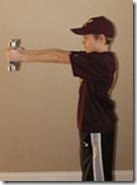
Front Shoulder Raise

Using dumbbells in each hand, raise both arms up in front parallel to the floor (no higher than the

shoulder). Hold for 1-2 seconds and slowly return back to your side. This exercise can be done with

both arms simultaneously or alternating one arm at a time. This exercise strengthens the anterior or

front deltoid muscles.

clip_image010clip_image012

Flys

Using a bench and dumbbells (make sure a spotter is used for safety), lay on your back with both arms

out to the side. Begin by bringing both arms up and together until they meet. An optional finish to this

exercise is to end with a punching action. This will work the serratus anterior muscle (helps keep the

shoulder in place). Slowly lower the arms back down until they are parallel to the floor (do not go

beyond this). This exercise works the chest muscles (pectoralis major). The push up can be used as a

substitute for this exercise (ending with a punching motion).

clip_image014image

Rear Flys

Using a bench and dumbbells, lay on your stomach. Using dumbbells, start with both arms hanging down.

Begin the exercise by lifting both arms together out to the side. Stop when your arms are parallel to the

floor. This exercise will strengthen the rear Deltoids as well as the upper middle back muscles known as

the rhomboids.

clip_image016clip_image018

Empty Can

Using a light dumbbell, beginning with arms at your side, turn the dumbbell inward as if to empty out a

can of pop (keep arm straight). The correct placement of the arm is very important in order to protect

and isolate the supraspinatus muscle (an external rotator of the shoulder). Lift the arm up at a diagonal

(if you were standing on second base, the direction you want to lift your right arm is towards third base

left arm towards first base), just below the height of the shoulder. Hold this for 1-5 seconds. Then slowly

lower the arm to the side.

clip_image020clip_image022

Note: always consult a physician before beginning any exercise program.

I highly recommend Shaklee’s Sports Nutrition Products.

banner_SportsNutrition

Never Let Up!  Coach Heas

Wednesday, June 22, 2011

Introducing Shaklee Sports Nutrition

Powering Athletes. Fueling Dreams. From Start to Finish!

First off, I want to say that I am a BIG believer in providing Today's Athletes young and old with the proper nutrition and training for helping them develop an athletic and health body. Since most athletes today don't always eat the best of foods (most adults don't either), I make sure my athletes start their day with a good breakfast and an effective vitamin for proper nutrition. In my 11+ years as a Shaklee Distributor, I have found that Shaklee's Multivitamins and Multiminerals are the most balanced and comprehensive supplements you can buy. At a minimum, your young athlete should take a Vita Lee Multivitamin providing 23 essential vitamins and minerals or for your more advanced athletes, the Shaklee Vitalizer which offers the best spectrum of vitamins, minerals, antioxidants, omega-3 fatty acids, and probiotics available.

I also want my athletes using the best sports nutrition products before, during, and after their workouts. The Shaklee Sports Nutrition package (Energy, Performance, and Physique) are again the best you can buy. These products are used at the highest level of compitition, including the U.S. Olympic Sking and Snowboarding teams endorsed by Troy Flanagan, Director of Sports Science for U.S. Ski and Snowboarding Association. In fact Shaklee has a long list of Athletes who endorse the Shaklee nutrition products.

Energy - Shaklee Energy Chews provide a clean burst of HEALTHY energy to help athletes get that extra edge when they need it most.

Performance - Shaklee Performance is clinically proven to hydrate better than water. Plus, Performance has more electrolytes and provides more energy than the leading energy drinks on the market. Performance minimizes fluid loss for enhanced hydration, maintains blood-glucose levels to sustain intense energy output, and increases endurance for better athletic performance.

Physique - Shaklee Physique is a pure, natural, high-octane fuel for rapid muscle recovery, endurance, and strength.

Through the month of July, Shaklee is offering a special for their Sports Nutrition Package. Get a FREE sports nutrition Pack ($75 retail value) when you join Shaklee with a $70 order or with a GOLD Pak! Click here for details.


Put in the Best, Bring out the Best!

Coach Doug

Welcome to Today's Athlete

I'm a Father to Seven boys and a Coach to them all. I have had boy's play Little League Baseball and Football, Travel Baseball, Legion Baseball, High School Baseball (First Team All Area) and Football, and College Baseball (4 Year Starter at The University of St. Francis). If there is one thing I have learned in my 25+ years of coaching sports, proper Technique, Training, and Nutrition are all equally important in developing a great athlete.

Come follow me as I post everything I know about developing a Great Athlete!

Coach Doug